

Core Elements
Each freeport consists of two main elements
- an outer boundary (ref. blue) within which customs incentives can be obtained
- identified specific areas (ref. red) in which tax incentives may be possible
Fiscal Incentives
The customs and tax incentives are very closely aligned for each freeport and available for qualifying businesses.
View tax site details
Click below to view further information on individual tax sites:
Scottish Green Freeports
In Scotland, Inverness Cromarty and Forth are designated as “green freeports” and require an adherence to net zero and fair work policy objectives to qualify for tax or customs support. The actual business activity itself does not need to be “green”, it must promote decarbonisation and a just transition to a net zero economy.
Forth River & Estuary
The River Forth is one of Scotland’s most important estuaries, stretching from Kincardine in central Scotland to the North Sea just beyond Edinburgh. It forms the natural spine of the nation’s east coast economy. The estuary reaches a width of 19 miles (30.5 km) at its widest point. Its maximum depth is 46 m (151 feet). It becomes tidal at Stirling.
Its wide tidal basin connects deep‑water channels, major ports and strategic industrial zones with global markets. Surrounded by a mix of coastal communities, energy infrastructure and internationally significant natural habitats, the Forth has long served as a gateway for trade, innovation and shipbuilding.
Prime Location
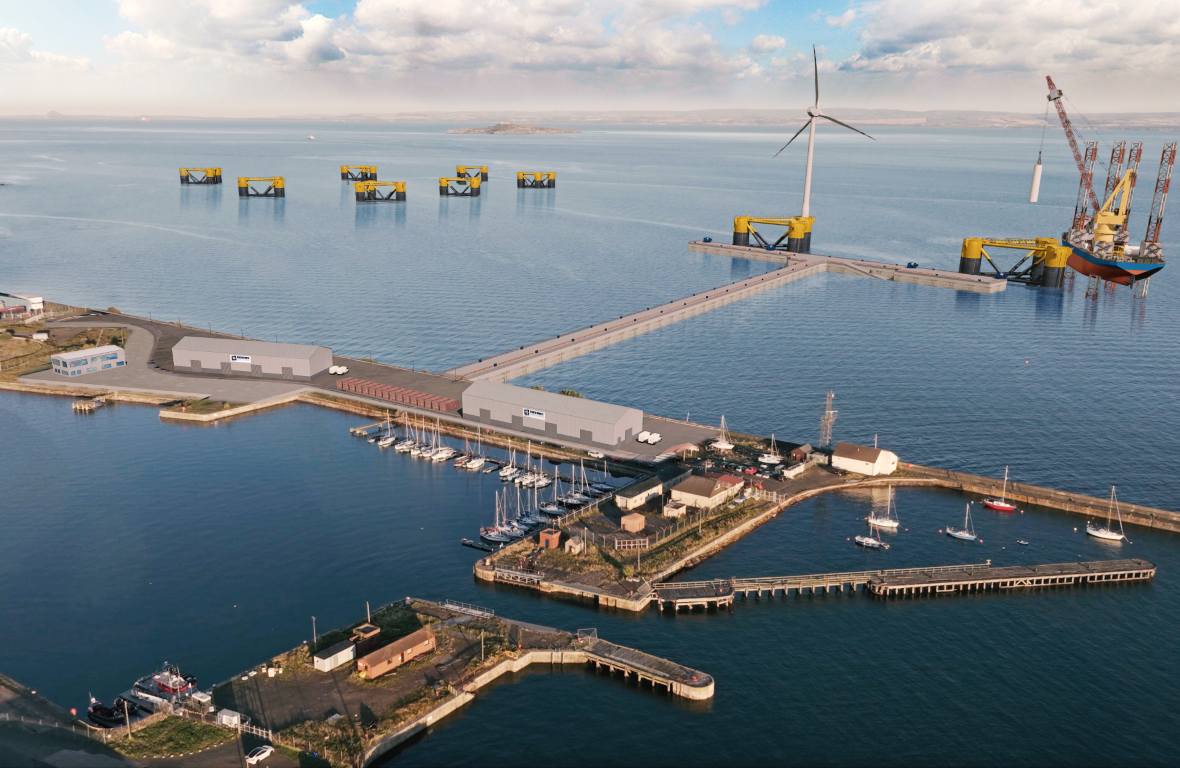
The Forth Green Freeport unites key deep‑water ports (Rosyth, Burntisland, Leith and Grangemouth) alongside integrated air, rail and road infrastructure. Together, they create the nation’s largest and most connected trade corridor, strategically located between Edinburgh, Fife and Falkirk with access to national transport networks and global shipping routes.
Together they handle over 9 millions tonnes of cargo worth £6 billion of goods annually, representing ~30% of Scotland’s GDP. Scotland’s largest container terminal moves around 250,000 TEUs per year.
Investment FAQs
Companies that qualify to receive tax or customs benefits within the freeport area, must first sign up to and demonstrate a plan to adhere to the FGF Net Zero Charter. In particular this requires a commitment to net zero for activities within the Forth Green Freeport area and to perform a whole life carbon assessment.
The tax and customs benefits are the same in numerical terms, although have different nomenclature e.g. stamp duty in England/Wales and land business transaction tax in Scotland. The Scottish green freeports also have net zero and fair work commitments.
The freeport financial levers are tax relief and customs duty deferral, rather than grant funding. The FGF is working closely with the Edinburgh and South Scotland City Region Deal and the Falkirk and Grangemouth Growth Deal.
Green Freeport status unlocks various tax incentives for businesses. For example:
- Land & Building Transaction Tax (LBTT) Relief.
- Enhanced Structures & Buildings Allowance (SBA): accelerated relief to reduce taxable profits by 10% of cost of investment every year for 10 yrs (compared to standard 3%p.a. over 33 1/3 yrs).
- Enhanced Capital Allowances (ECA): reduce taxable profits by full cost of qualifying investment in new plant/machinery in same tax period as cost was incurred.
- Employer NICS: 0% employer NICs on salaries of any new employee working in Green Freeport tax site. Applicable for <3 yrs per employee on earnings <£25,000p.a. threshold.
- Non-Domestic Rates Relief (NDRR): Businesses may be eligible for <100% relief from NDR on certain properties and property improvements within tax sites for <5 yrs from point of first relief.
Project Willow is a project run by Scottish Enterprise, on behalf of the Governments of the UK and Scotland. The Project Willow report identified nine credible projects. These initiatives have the potential to significantly enhance low-carbon manufacturing across the UK and create a positive future for Grangemouth. To find out more click here or email the Scottish Enterprise Grangemouth enquiry Service: grangemouth@scotent.co.uk
233 HA of land within the Grangemouth cluster is part of the Forth Green Freeport. Therefore the FGF is working closely with Scottish Enterprise and both Governments to attract investment that will support the just transition of the Grangemouth cluster
The Green Freeport policy discourages economic displacement, meaning investment into a tax site should represent additional economic activity. Therefore if a business that is currently located within the UK wishes to relocate to a FGF tax site due to growth or expansion, the proposal must demonstrate that no appropriate expansion space is available at the current site. In addition, reliefs would only apply to the additional economic activity. Local companies within the FGF outer boundary area can also explore the use of a Green Freeport Customs site to facilitate international trade.
the freeport is an economic regeneration programme, and so as the freeport activity ramps up it is anticipated that this has a positive effect more widely, particularly for companies involved in the supply chain of the freeport priority sectors.
See the our sites section, together with those of the individual landowners and local authorities. Please also get in touch with any further questions.
Please Consult each site landowner for specific information re. available power grid connections. An integrated utilities study is underway for the freeport are since Q1’26.
There are provisions for developments that straddle a tax site boundary to qualify, either in full or part, depending on certain prescribed criteria. These are outlined in the HMRC Freeport FAQs
No, funds of this sort are not available.
The seed capital budget has already been fully committed. Projects were identified during the development of the Forth Green Freeport business case.
Useful Information & Resources
Scottish Government Incentives
Hydrogen Production and Export Locations Site Requirements Study
Local Authorities
Edinburgh
- Investment – https://www.investinedinburgh.com/
- Planning – https://www.edinburgh.gov.uk/planning
Falkirk
- Investment – http://www.investfalkirk.com/
- Planning – https://www.falkirk.gov.uk/development-management/planning-applications-and-decisions
Fife
- Investment – https://www.investfife.co.uk/
- Planning – https://www.fife.gov.uk/kb/docs/articles/planning-and-building2/planning/planning-applications/view,-track-and-comment-online
Forth Estuary
- Forth Estuary Forum – https://www.forthestuaryforum.co.uk/
- Forth River Trust – https://forthriverstrust.org/
Scottish Government Agencies
- Scottish Enterprise / Scottish Development International – https://www.scottish-enterprise.com
- Business Gateway – https://www.bgateway.com/
- SNIB – Scottish National Investment Bank – https://www.thebank.scot/
Scottish Public Bodies
- Crown Estate Scotland – https://www.crownestatescotland.com/
- Nature Scot – https://www.nature.scot/
- Scottish Environmental Protection Agency – https://www.sepa.org.uk/
- Marine Scotland – https://marine.gov.scot/
- Skills Development Scotland – https://www.skillsdevelopmentscotland.co.uk/
UK Government
- Office for Investment
- Department for Business and Trade
- Ministry of Housing, Communities and Local Government
Aligned Economic & Skills Interventions
- Edinburgh and South East Scotland City Region Deal – https://esescityregiondeal.org.uk
- Tay Cities Region Deal – https://www.taycities.co.uk
- Falkirk and Grangemouth Growth Deal – https://www.gov.uk/government/news/100m-falkirk-and-grangemouth-growth-deal-signed
- Grangemouth Industrial Transition Plan – https://www.gov.scot/publications/grangemouth-industrial-transition-plan-supporting-fair-transition-scotlands-core-manufacturing-cluster/
- National Transition Training Fund – https://www.gov.scot/policies/employability/national-transition-training-fund/
- Scottish Local Growth Fund – https://www.gov.uk/government/news/140m-scottish-local-growth-fund-to-drive-economic-growth
Chambers of Commerce
- Edinburgh Chamber of Commerce – https://www.edinburghchamber.co.uk
- Fife Chamber of Commerce – https://www.fifechamber.co.uk
- Forth Valley Chamber of Commerce (covers Stirling, Falkirk, Clackmannanshire) – https://forthvalleychamber.co.uk
- West Lothian Chamber of Commerce – https://www.wlchamber.com