
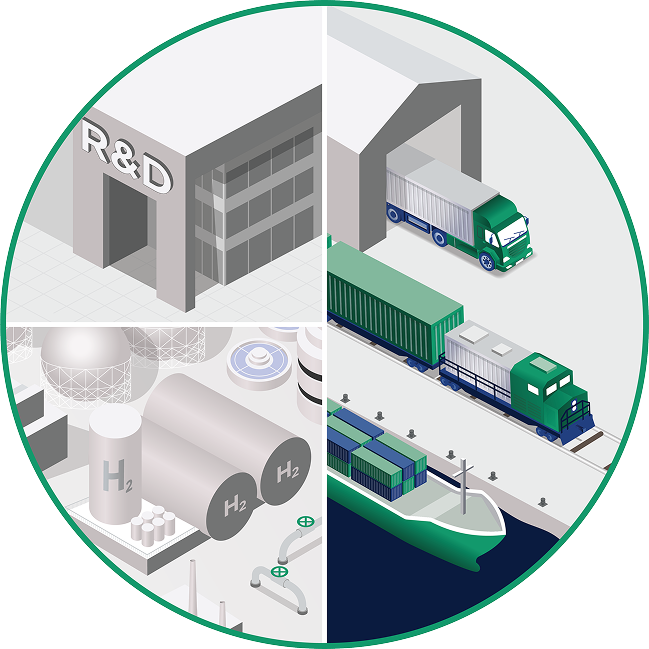
Customs Incentives
Each Freeport customs site is run by a customs site operator. Authorised businesses within the customs site can take advantage of the Freeport customs benefits. Some customs sites will contain multiple businesses, others will be mainly used by the customs site operator.
Businesses authorised by HMRC and operating inside designated customs sites in the Freeport can store or process imported goods. They can then export them or declare them for free circulation (home use) in the UK.
- Authorisation – Permits storage and processing activities under one combined Freeport customs special procedure, instead of multiple authorisations.
- Imports –simplified declaration for non-controlled goods using form C21. Duty can be suspended on imports into a customs site.
- Exports – Duty exemption is available on goods being re-exported from a Freeport customs site.
- Free circulation –flexibility on how duty is calculated for goods processed within the customs site.
- Movement between customs sites – simplified process for moving most goods between customs sites with duty remaining suspended, including sites at other UK Freeports.
- Storage and processing – Goods can be moved between storage and processing without additional declarations. Goods can also be stored under duty suspension until needed.
Tax incentives
There are five direct financial incentives for locating at a tax site. These are a mixture of reliefs (reductions) and deferments
- Land and Buildings Transaction Tax (LBTT) – Relief on qualifying non‑residential land and property purchases or leases within tax sites (full or partial relief, up to five years).
- Enhanced Structures and Buildings Allowances – allowing accelerated tax relief on construction or renovation of commercial buildings.
- Enhanced Capital Allowances – offering 100% first‑year relief on qualifying new plant and machinery investment within tax sites.
- Non‑Domestic Rates Relief – funded by the Scottish Government for eligible properties or improvements for up to five years.
Ref. UK Gov – https://www.gov.uk/guidance/scottish-green-freeports-subsidy-scheme
Key Timescales
Each UK freeport has a ten year window within which to claim the tax reliefs. Sunset dates were set centrally:
- 30 September 2031 in respect of English Freeports
- 30 September 2034 in respect of Scottish Green Freeports and Welsh Freeports
Planning Support
[Some text about planning protocol]Ref. SG Planning Protocol – https://www.gov.scot/publications/green-freeports-planning-and-other-consents-national-protocol/
Innovation & Skills
[Some text high level about investor support, link to other FGF pages]Ref. other pages
Seed Capital
[Some text high level about Seed]Make it clear this is pre-allocated
The FGF does not provide funding to businesses.
Qualifying Investment
TIMELINE
For the Forth Green Freeport, 30 September 2034 is the date by which the business activity must be operational. The reliefs or allowances may continue beyond that date i.e. 3 years for national insurance and 5 years for non-domestic rates.
Ref. Designation – https://revenue.scot/news-publications/news/designation-forth-green-freeport-tax-sites
Ref. Scot Gov Legislation – https://www.legislation.gov.uk/uksi/2024/671/made
PRIORITY SECTORS
Priority will be given to businesses within the following sectors:
- Offshore wind
- Alternative fuels, production and distribution
- Modular manufacturing
- Shipbuilding
- Chemicals production
- Logistics and warehousing
- Creative Industries
Limited exceptions can be considered subject to the investor being:
- complementary to the priority sectors, or
- providers of ancillary services which support businesses within the FGF area/or
- overall contributors to the FGF objectives
Each investment should provide additionality in terms of net new jobs, investment, and accelerated growth.
CORE COMMITTMENTS
Each investor must also sign up to and adhere to the FGF core commitments. Performance against each core commitment will be monitored and evaluated.
Net Zero
To be eligible for FGF benefits businesses must commit to the FGF Net Zero Charter i.e.:
- commit to reach the Scottish Government’s target of Net Zero by 2045
- complete a whole life carbon assessment for their development, and
demonstrate how they are considering positive net zero choices in the creation of their new development, in line with industry best practice.
Fair Work
The Fair Work Charter sets out expectations for all employers and partners operating within the Forth Green Freeport.
It builds on the Scottish Government’s Fair Work Framework and Fair Work First criteria, and adopts a progressive model of Aspiring, Achieving and Excelling standards across the core dimensions of Fair Work.
Skills Fund
To access FGF tax benefits, investors are required to contribute to a FGF Skills Fund which will support the delivery of the FGF Skills Plan. Each investor is required to pay 5% of employer realised National Insurance (NIC) savings towards the Skills Fund.
MONITORING AND EVALUATION
Once the investor has commenced operations at the FGF site, they are required to provide relevant data to the FGF to enabling monitoring against the investor performance and commitments. Monitoring data is expected to be reported on a 6 monthly basis, although some data may be required less frequently.
INVESTOR ONBOADING
The FGF will engage with businesses, both existing and proposed, to enable them to understand the potential benefits and the requirements commitments.
The FGF is strongly supported by the landowners, local authorities and investment agencies, who each play a key role.
The main steps are anticipated to be:
- Engage – identify and support companies and opportunities
- Screen – assess the potential feasibility and fit
- Review – receive and review a business proposal
- Confirm – details related to net zero, fair work, security etc
- Implement – support the company in seeking tax relief
- Monitor – ongoing monitoring and evaluation
The start of the onboarding process is an Enquiry Form, and the end will be an End User Agreement confirming the agreed site and the company commitments to net zero, fair work and monitoring.