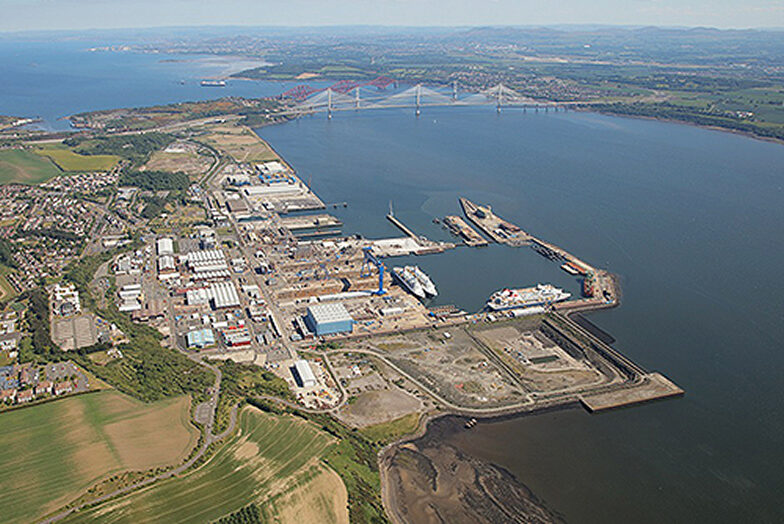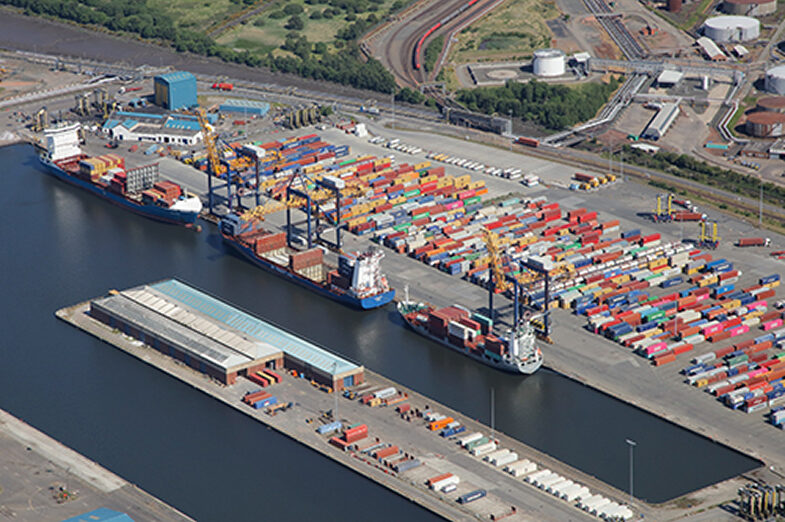
The Forth Green Freeport sits at the heart of one of the UK’s most exciting innovation corridors.
Stretching across the Forth estuary and Scotland’s Central Belt, the region combines major ports, active industrial sites and established supply chains with world-class research, global connectivity and a fast-growing innovation ecosystem.
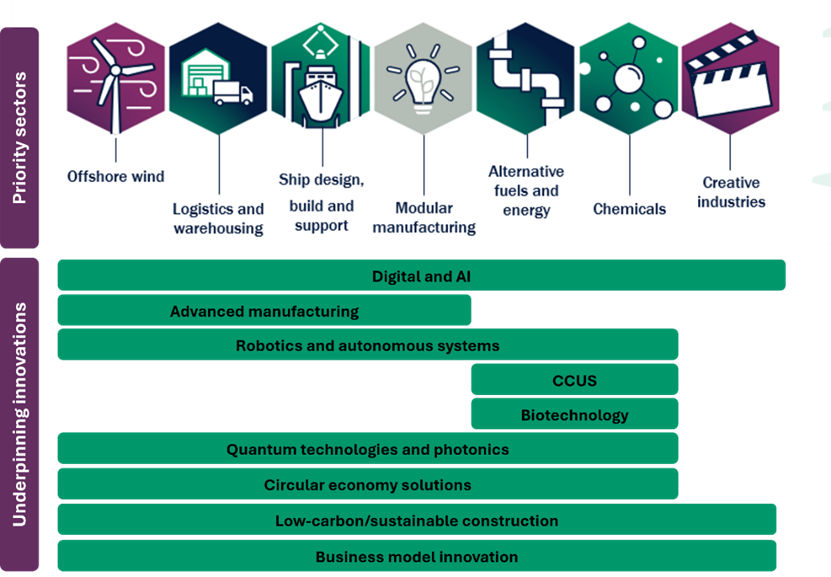
Forth Green Freeport is driving innovation across high-growth sectors including offshore wind, logistics, shipbuilding, modular manufacturing, alternative fuels, chemicals, and creative industries.
These sectors are powered by cutting-edge capabilities across the region, such as in digital technologies and AI, advanced manufacturing, robotics, carbon capture and storage (CCUS), engineering biology, quantum technologies, photonics, circular economy solutions, and sustainable construction.
Forth Green Freeport is investing in key infrastructure across its tax sites to test new solutions, support SMEs, and drive innovation:
Arol Gibb Innovation Campus (AGIC) – Rosyth: AGIC will be a new hub for advanced manufacturing and marine innovation. It will give SMEs access to flexible workspace, specialist equipment, and live industrial environments for prototype testing – helping accelerate technologies from development to deployment. AGIC will also create opportunities for collaboration with industry and academia, enabling businesses to solve real-world challenges and bring new products and processes to market faster.
Grangemouth Sustainable Manufacturing Campus (GSMC) – Grangemouth: GSMC will provide pilot and demonstration-scale facilities for companies developing sustainable chemical and bio-based technologies. With a focus on industrial biotechnology, engineering biology, and chemical process innovation, the campus will help businesses test, scale, and commercialise solutions in an industrial setting – opening up new markets and driving growth in low-carbon manufacturing.
Leith Dry Dock Development – Harbour 38: This mixed-use development will offer modern facilities for SMEs working in offshore wind, renewables, creative industries, and other innovative sectors. Located in a prime position at Leith Harbour, the site will provide businesses with high-quality space and a collaborative environment to grow and connect within Scotland’s thriving innovation ecosystem.
Innovation Support:
Businesses locating at Forth Green Freeport can access a strong network of support to help them innovate and grow. Scottish Enterprise, Scotland’s national economic development agency, provides tailored advice on funding, innovation, and market development, helping companies scale and succeed. Local authority investment teams offer practical support for setting up and expanding operations, including guidance on planning, connections to local supply chains, and access to skills initiatives. Together, these partners ensure businesses have the resources and connections they need to thrive within the Forth Green Freeport.
Local Universities
The universities in our region are engines of innovation, bringing expertise and world-class research that can support businesses working in our priority sectors:
Heriot-Watt University: robotics, autonomous systems, advanced manufacturing, carbon capture.
The University of Edinburgh: data science, artificial intelligence, digital technologies, engineering biology.
Edinburgh Napier University sustainable construction, renewables, digital creativity, nature based solutions.
University of Stirling: environmental science, climate and land-use systems, circular economy, water systems research.
University of Strathclyde: engineering, wind and marine energy systems, maritime engineering and naval architecture.
University of St Andrews: chemistry and materials science, renewable energy technologies, hydrogen and alternative fuels, quantum technologies.
Specialist facilities and innovation centres
Some examples of innovation centres of excellence, across the region, which are available to support business to test solutions, access expertise, collaborate and innovate.
- The Kelvin Hydrodynamics Laboratory ( University of Strathclyde) provides specialist towing tank and wave basin testing to support ship design, offshore wind vessels and marine technology innovation.
- FASTBLADE at Rosyth is a specialist facility for advanced composite blade manufacturing, supporting the development, testing and production of large-scale wind turbine blades.
- Maritime Research and Innovation UK (MarRI-UK) (University of Strathclyde) is an industry-led membership organisation that drives the global competitiveness of the UK maritime through extensive partnerships in identifying, developing, and leveraging emerging technologies.
- Industrial Biotechnology Innovation Centre (IBioIC) connects industry and academia to commercialise industrial biotechnology, supporting the development of sustainable chemicals, materials, fuels and circular bio-based processes.
- GENESIS Energy Conversion and Storage Centre (University of St Andrews) focuses on the advancement of hydrogen technologies and providing SMEs with access to university expertise and facilities to scale up their innovations.
- Industrial Decarbonisation Research and Innovation Centre (IDRIC) leads UK-wide research to accelerate the decarbonisation of the energy intensive industries. It connects academia, industry, and policymakers to develop technologies, systems, and strategies that reduce emissions and enable a net zero economy.
- National Robotarium (Heriot-Watt University and University of Edinburgh) is the UK’s leading robotics and AI centre, delivering research and solutions in automation and intelligent systems to drive innovation in advanced manufacturing, offshore energy, and logistics.
- National Manufacturing Institute Scotland (NMIS) supports companies to develop, test and scale advanced manufacturing technologies, with a focus on digital manufacturing, productivity and low-carbon processes.
- Bayes Centre (University of Edinburgh) is Scotland’s innovation hub for data science and AI. It connects global enterprises and start-ups with world-leading academic expertise, cutting-edge technologies, and collaborative networks to unlock opportunities through advanced analytics, computing, and engineering.
- Edinburgh Parallel Computing Centre (EPCC) is UK’s first National Supercomputing Centre and a leading hub for high-performance computing, AI, and big data analytics. It provides advanced infrastructure and expertise to accelerate research and industrial innovation across sectors.
- Centre for Cybersecurity, IoT & Cyberphysical Systems (Napier University) supports innovation in secure digital infrastructure, connected devices and intelligent physical systems. The Centre helps organisations design, test and deploy resilient digital technologies across complex operational environments.
- Transport Research Institute (Napier University) delivers applied research in transport systems, freight, logistics and mobility, with a focus on efficiency, resilience and decarbonisation. Its work supports data-led decision-making and innovation across transport and supply-chain operations.